Spotlight: Lewis Evans
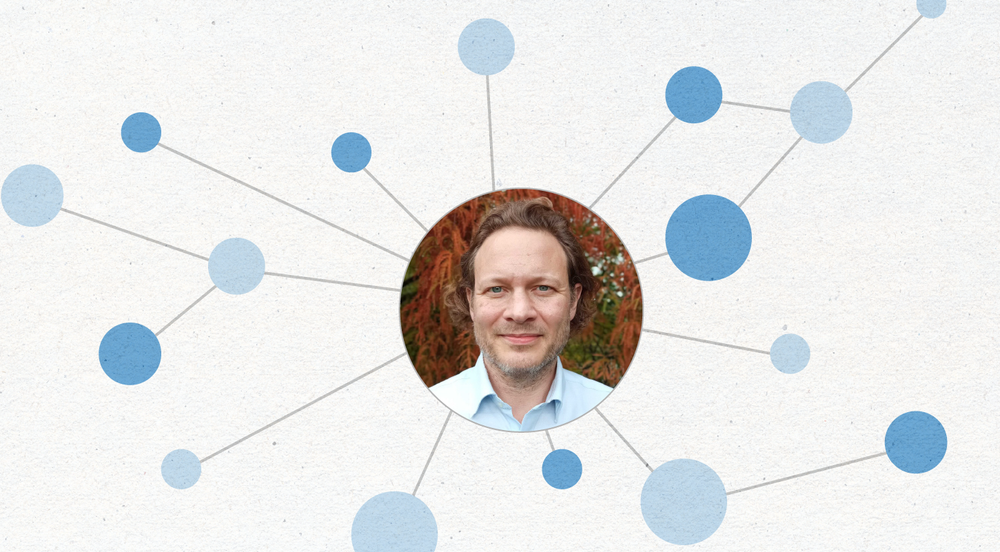
Lewis Evans is an Open Targets project lead and Senior Staff Scientist at the Wellcome Sanger Institute.
As part of his project NeuroFlux, Lewis interacts with many people across the consortium. “The neuro community at Sanger is very collaborative” he says. “I work closely with Andrew Bassett, we share a lot of the same technologies and I’ve been able to apply some of the cell engineering methods Andrew has developed. It’s nice to be able to interact with people and bounce ideas off them.”
Lewis’ project studies neurodegeneration, seen in diseases such as Alzheimer’s disease, Parkinson’s disease, and other related dementias, from a genetic standpoint. His team uses the rare familial forms of Alzheimer's and Parkinson's as genetic anchors to look at the extremes of the disease. Since these forms of dementia tend to be more aggressive, they also allow us to understand the disease in a realistic timeframe.
“The scale of projects is unusual for me. My previous projects have focused on a pathway or a set of genes, whereas these projects are much much bigger than that. The scale of the data is much larger, and there are a lot of large datasets that are available to compare your data to, which is very cool.”
Lewis’ background is in protein folding, and in particular, what happens when protein folding goes awry. One of the key hallmarks of Alzheimer’s disease is the aggregation of misfolded proteins in the brain, which form plaques. “I was interested in how those plaques form, an area of biochemistry that wasn’t particularly well known at the time.”
In his project with Open Targets, Lewis is examining another disease hallmark. Autophagy and lysosomal pathways are a cell’s recycling trash chute, and are essential for the cell’s health. These pathways are dysregulated in old age and dementia, and it’s thought there may be a link between these pathways going wrong and the formation of the protein aggregates.
“The chances are that a lot of the hallmarks that people see — and there are many — are all interconnected and one can exasperate another. One hallmark might be particularly strong in one individual because of their genetics or lifestyle, and in another person it could be different.
There’s been a lot of interest in the immune system, looking at how immune cells in the brain impact on disease, based on recent studies suggesting that the immune system is an important component of neurodegenerative diseases. So more and more focus is pushing in that direction, and that’s true of projects within Open Targets, with a recent call for projects centred on neuroimmune research specifically.”
Lewis is carrying out whole genome CRISPR screens in cells with autosomal lysosomal dysfunction, systematically knocking out every gene individually in the genome, to see whether this can bring back the normal levels of autophagy or lysosomal activity.
“We’ve also added a second dimension to the screens, in order to also measure the health of the cells. It’s definitely complex.” Lewis says. He estimates the team has carried out over 100 whole genome CRISPR screens, and to date they estimate that they’ve grown at least 5 billion neurons. “But then, a human brain has about 80 billion cortical neurons, so we’re not quite there yet!”
“The scale at which we’re doing things, and in such an unbiased way, means that anything could come out of it. You have to be open to a new theory or something completely out of the ordinary happening.”